
Click 2 times for the time of your life!
JAZZ TOUR INFORMATION


Return to Big Apple Jazz

Harlem's Tree of Hope
Email

Scroll down for history, video and more photos...

View of "The Corner" of 131st and 7th Ave in Harlem showing Connie's Inn, The Tree of Hope and the Lafayette Theatre circa 1920's View of "The Corner" as described in Mezz Mezzrow's, Really The Blues.  Photo credit: Gordon Polatnick 7/7/2007


Archival photo of the Tree of Hope stump, courtesy of Hansel Mieth/Timepix.  "Nestled between the Lafayette Theatre and the popular nightclub Connie's Inn, a tall [elm] tree was rumored to bring good luck to all who touched it.

During the Harlem Renaissance, aspiring performers such as Ethel Waters, Fletcher Henderson, and Eubie Blake were rumored to have visited the Tree of Hope.

When the tree was cut down in 1934 during the expansion of 7th Avenue, it was cut into logs and sold as souvenirs. One section was salvaged and found a home at the Apollo Theater, where today's amateur performers continue to rub the trunk in the tradition of their predecessors.

In 1941, Bill 'Bojangles' Robinson joined New York Mayor Fiorello H. LaGuardia in a formal ceremony to rededicate the stump of the original tree."
~ http://artsedge.kennedy-center.org/exploring/harlem/infocredits/credits/imagecredits.html


Current photos of Al Miller's Tree of Hope III (L) and the new Tree of Hope (R) photo credits Gordon Polatnick, Big Apple Jazz, LLC

This New Tree of Hope (#4) was planted in June 2007 by the NYC Parks Department at the request of the Copasetics Connection.


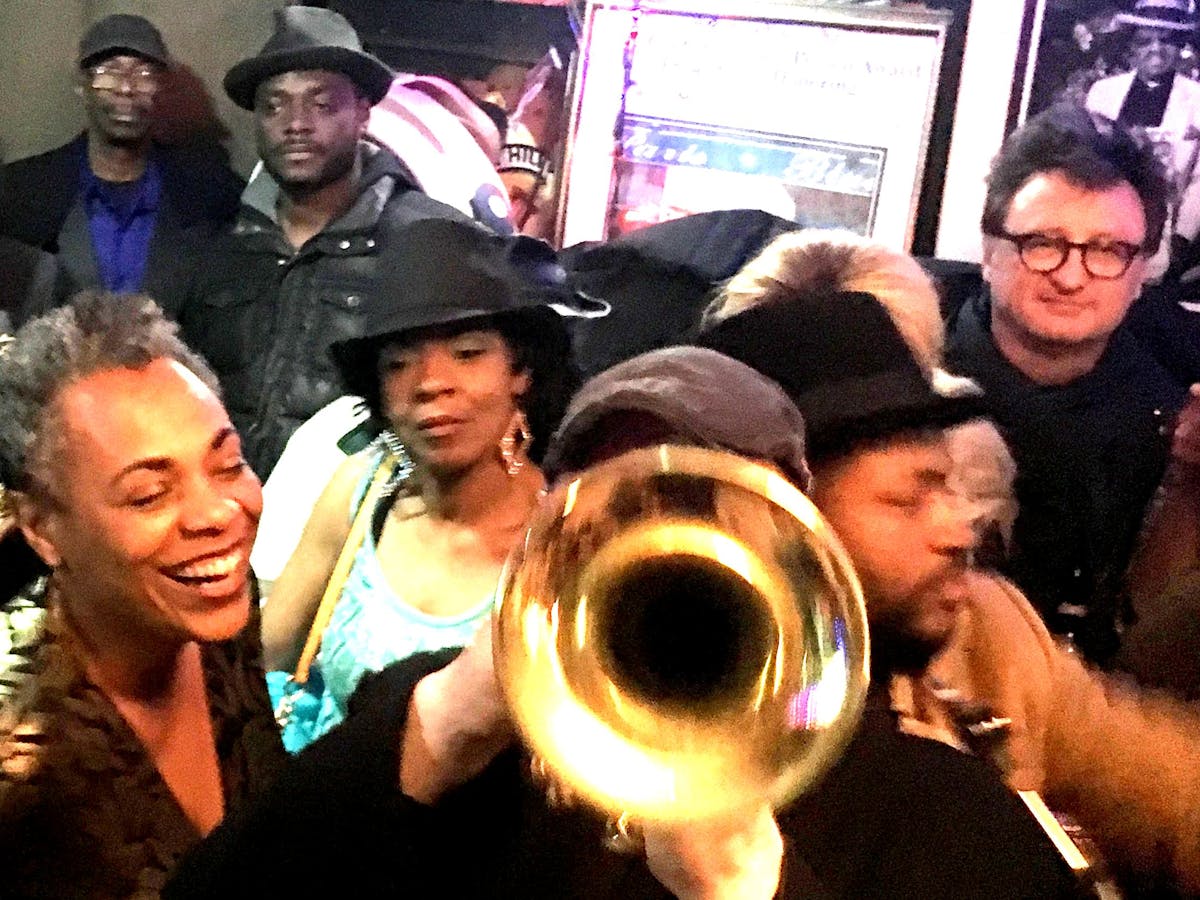
The Big Apple Jazz / EZ's Woodshed
Keeping the tradition alive
Across the street from the Tree of Hope
2236 Adam Clayton Powell Blvd between 131st and 132nd Streets. 
tel. 212 283-JAZZ (5299)
OPENS DAILY AT 10:30am 
LIVE JAZZ ALL DAY FROM 2PM

Email us

2236 7th Ave. (Adam Clayton Powell Jr. Blvd)
131st / 132nd Streets

Gordon Polatnick opened up Big Apple Jazz and EZ's Woodshed on this historic block at the beginning of 2006 as a living tribute to the spirit Harlem's legendary Tree of Hope.  With live jazz daily starting at 2PM and a great selection of memorabilia, EZ's Woodshed offers fans of New York City Jazz an inviting cafe atmosphere in which to celebrate the past as we thrill in the present scene among the world's finest jazz musicians. 
Click on this video below.


Big Apple Jazz / EZ's Woodshed in Harlem across from the Tree of Hope
Keeping the tradition alive
Across the street from the Tree of Hope


Tree of Hope History from the Hoofer's Club UK

"The elm tree became known as a kind of wishing well among the Harlem show people. It was believed that by touching, stroking or kissing the bark of the tree, your wishes would come true. This belief was mainly among the entertainment fraternity who would always hope to be hired in a club or much better a show some where which guaranteed employment for a period of time. It was also used as a good luck charm before you were about to perform. Performers would dance for money or dance and practice moves around the tree, it was almost like an open air Hoofers Club and so "The Tree of Hope" was born.
 
As the elm tree was in the heart of Harlem's club and theatre land it became a natural place where agents and people in show business would gather and as a result many entertainment jobs were handed out under the shade of the tree. It was also this reason that reinforced reputation of the tree's luck. The tree brought good luck, hope and fortune to all that came to know the importance of its majestic symbolism.
 
In 1930s plans were made to widen Seventh Avenue and the tree was to be cut down. Many actors, singers and musicians protested against this action, but the impending doom of the tree was final. The tree it's self by that time was in bad condition and was not the prettiest of sites in Harlem. Many people desperate to keep some thing of the tree ripped off pieces of the bark and kept them as good luck charms.
 
The managers of the newly opened Apollo Theatre, knowing of the deep symbolism of the 'Tree of Hope', managed to obtain part of the stump and placed it beside the Apollo stage. It was for performers to touch for good luck and it actually became an insult if you did not rub the stump as you entered the stage. It was said that about eight out of ten amateurs who attended the amateur night to show their talent got lucky and found gigs. However, every one rubbed the stump so no comparison could be made with those who didn't touch the stump.

Bill Robinson, who at the time was an honorary Mayor of Harlem, also managed to preserve a section of stump from the original tree. He kept it by the stage entrance of the Lafayette Theatre, he then appealed to the acting Mayor at the time for help. After the work on Seventh Avenue had been completed a new tree was planted and the old stump of the original tree was placed beside it with a plaque that read. 'The original Tree of Hope Beloved by Citizens of Harlem. You Asked for a Tree of Hope, So here 'Tis and Best Wishes – Bill Robinson.'"    ~ http://web.ukonline.co.uk/tc/hoofersclub/


p.143 of: "New York -Oddly Enough", by Charles G. Shaw


THE LEGEND OF THE TREE OF HOPE
Apollo Theatre

The legend and tradition of The Tree of Hope began outside the famous Harlem Lafayette Theatre once located between 131st and 132nd Streets on Seventh Avenue, known as the Boulevard of Dreams. The Lafayette was then Harlem's top show biz venue featuring African-American talent. The Lafayette soon became the scene for aspiring actors, dancers and performers to mix, gather and exchange information and gossip.

The Tree of Hope stood between the Lafayette Theatre and Connie's Inn and black performers believed the tree to be the purveyor of good luck to those who stood beneath its branches. The tree came to symbolize the promise that Harlem held for millions of aspiring African-Americans.

Around the time that the Apollo Theater first opened in 1934, the City of New York widened Seventh Avenue and the trees that had once lined the Boulevard of Dreams had to be removed. One of the trees doomed to this fate was the famous Harlem landmark, The Tree of Hope.

The tree was cut up as firewood and pieces were also sold as good-luck souvenirs. Ralph Cooper Sr. bought a piece of the tree that measured eighteen inches across and sat about a foot high. He took it back to the Apollo and had it sitting in his dressing room. Just before the first Amateur Night at the Apollo show began, he asked one of the stagehands to sand and shellac the log and to mount it on an iconic column. The column pedestal was placed stage right, just outside the curtain so the audiences could see it.

As word spread that this unassuming log was part of the once great Tree of Hope, it became a tradition of Amateur Night to have each contestant touch the tree on the way to center stage. Since then, every single performer that has appeared on Amateur Night has touched that log. Within a year of its debut, its surface was as smooth as glass from all the now famous and not-so-famous hands that had touched or rubbed it.

Now, touching The Tree of Hope has become recognized as the famed Apollo ceremonial act carried out by all Amateur Night performers before they compete.  Rooted between a glorious past and an even greater future, the Tree of Hope links generations of performers together in an unbroken tradition of chance, desire and success.
~http://www.apollotheater.com/amateur4_5.shtm


"Tree of Hope III"
Before its facelift

Al Miller's Tree of Hope III photo credit: Gordon Polatnick
Photo credit Gordon Polatnick


"Tree of Hope III"
Today with sculptor Algernon Miller

Newly repainted Tree of Hope with its creator Algeron Miller, 2004, photo credit Jonathan Kuhn
photo credit Jonathan Kuhn

Sculptor Algernon Miller, 1972, restored 2004
Center median at Adam Clayton Powell Boulevard at 131st Street,
 Manhattan Painted steel ~ nyc.gov

Wednesday, April 07th, 2004

A Harlem treasure has finally returned home. After extensive conservation, the vibrantly colored abstract Tree of Hope sculpture returned to its original location last week at Adam Clayton Powell Boulevard and 131st Street in Manhattan. The piece was reinstalled by Parks & Recreation’s monuments and operations crews. The sculpture’s artist, Algernon Miller, was at the site to oversee its placement.

"I’m happy that it's up," said Miller, of the installation. "It was up there in a terrible condition for so many years, and it wasn't helping my career any. I'm grateful to The Lower Manhattan Cultural Council for their grant. I'm just so happy to see it up, and I'm hoping that the community enjoys it."

Originally installed in 1972, this abstract, painted-steel sculpture by Algernon Miller (b. 1945) symbolically commemorates the original Tree of Hope that stood opposite the Lafayette Theater at 131st Street and Seventh Avenue (now Adam Clayton Powell Boulevard). Many celebrated performers, including Bill "Bojangles" Robinson, rubbed the original tree for good luck.

The restoration of the artwork was carried out by Mr. Miller, with the support of a $5,000 grant from the Fund for Creative Communities, a joint program of the Lower Manhattan Cultural Council and the New York State Council on the Arts. Looking at original photographs and based on his own experience, Miller recreated the colorful painted surface of the steel tree and added a new protective coating. The Housing Development Fund Corporation of Harlem, a social service and transitional housing center, provided a work studio to Mr. Miller while he conserved and repainted the sculpture. Parks & Recreation masons rebuilt the concrete base for the sculpture to stand on.

Mr. Miller is engaged as one of two artists currently designing the memorial to Frederick Douglass at Frederick Douglass Circle (northwest corner of Central Park). The Tree of Hope was originally commissioned under the auspices of the Creative Artists Public Service Program in conjunction Harlem Cultural Council. ~http://www.nycgovparks.org

DATE: Wednesday, March 31, 2004

TIME: 10:00 - 11:30 a.m.

LOCATION: Adam Clayton Powell Boulevard and 131st Street
Manhattan

EVENT & PHOTO-OP: After extensive conservation, the vibrantly colored abstract tree sculpture will be reinstalled by Parks & Recreation’s monuments and operations crews. The sculpture’s artist, Algernon Miller, will be at the site to oversee its placement.

CONTACT: (212) 360-1311

Books relating to the Tree of Hope


  Essay by Theodore Grunewald, Chief Archivist Quadriga Art, Inc.
Posted to LISTSERV @ Miami University
15 Jan 2001

Dear Mr. Thomas,

You will be pleased to know that a photograph of the Tree of Hope will be found on p.143 of: "New York -Oddly Enough", by Charles G. Shaw, (Farrar & Rinehart, New York & Toronto, 1938, Library of Congress Catalog number 38011587), though now, long, long out-of print. Please bear in mind that this is a photograph of the second Tree of Hope replanted on, or near the same spot, which was donated in the 30's by the renowned tap dancer Bill (Bojangles) Robinson after the first was felled due to the exigencies of street engineering. Barely visible in the photo may be the faint outline of a brass plaque that Robinson had set into the sidewalk beneath the tree. Upon the plaque was inscribed: "The Original Tree Of Hope Beloved By the People of Harlem -You asked for a tree of hope so here it is, Best wishes," concluding with his signature. Unfortunately, I cannot tell the species of the tree from the photograph, nor do I know what became of the plaque.

This second Tree of Hope vanished in the intervening years, and a commemorative sculpture by the artist Algernon Miller was installed on the spot sometime around 1972. The second Tree of Hope, like the first, stood in the traffic island in the middle of Seventh Avenue (now Adam Clayton Powell Jr. Blvd.) opposite the Lafayette Theatre, at 131st Street; NOT in front of the Apollo Theatre at 253 West 125th Street, as is often erroneously believed. As you probably already know, the first Tree of Hope was the spot where out-of-work singers, dancers, and actors gathered to trade gossip and listen for news of gigs. From there, it's easy to see how the legend originated that performing in front of the tree was thought to bring good luck to African-American artists who had fallen on hard times.

In later years, Harlem residents believed that the tree would bring good luck to anyone who rubbed their back against it. I believe that confusion over the original location of the tree may have arisen because what remains of the stump of the second tree is kept onstage at the Apollo Theatre where aspiring stars rub it for good luck before curtain time. (Both Bill Bradley and Al Gore touched this relic before appearing onstage at the Apollo for a Campaign 2000 debate last year; not that it did either of them much good; perhaps they didn't rub hard enough.)

The Lafayette Theatre (now the Williams Christian Methodist Church) is still standing, at 2225 7th Avenue between 131st and 132nd Streets. According to Norval White's AIA Guide to New York, it was the Lafayette Theatre that not long after its construction in 1912 became the leading black theatre for the nation and remained so for over 30 years. In fact, it was the sensational 1913 production of "Darktown Follies" that established the vogue for downtown New Yorkers to flock to Harlem for late-night entertainment.

He further states that the Apollo did not become a venue for black performers, nor welcome African-American audiences until 1934, when the color bar was lifted and the theatre re-named the Apollo after 20 years as Hurtig & Seamon's New Burlesque Theatre.

In November 1921, riding on the popularity of Noble Sissle's and Eubie Blake's hit: "Shuffle Along" the "Shuffle Inn" opened on 131st St. in a basement space adjoining the Lafayette Theatre. According to research done by Murray L. Pfeffer, the club was purchased shortly thereafter by Connie and George Immerman; German immigrants who had originally owned a Harlem delicatessen where, as a teen, Fats Waller had worked delivering groceries. In June 1923 a new entrance to the club was opened on the 7th Avenue side, at no. 2221 Seventh Avenue, and the Shuffle Inn was renamed Connie's Inn. The club became immensely popular throughout the 20's thanks to great jazz ensembles like the Don Redman Band.

Connie's place in musical history was guaranteed when Louis Armstrong arrived from Chicago and made the club his base in 1929. A photograph from this era, with the signage for Connie's Inn heavily retouched, shows what is reputed be the first Tree of Hope, in the meridian of Seventh Avenue, with the Lafayette Theatre in the background. Although the Tree of Hope was said to have been outside of Connie's Inn; I do not yet know the origins of this photograph nor, the precise location of the tree relative to the Lafayette Theatre building. Whether this is the actual Tree of Hope is impossible to determine with certainty at this point. I am indebted to Sonny Watson of StreetSwing.com for this photograph; here is the link, so that you may assess it yourself. http://www.streetswing.com/histclub.htm When you arrive on the page, click on the "S" in the top-of-page index bar, and scroll down the chart to the "Shuffle Inn". Move across the chart to the next column, and click on the "Connie's Inn" link. (A .jpg image is attached below for those without web browsing.) Any further light that you, or anyone else can shed on the date and origin of this mysterious photograph would be greatly appreciated.

One can deduce that the circumstances and lore surrounding the first Tree of Hope grew up not long after, if not in direct connection with the 1913 success of the production at the Lafayette Theatre, and the artistic triumphs of the 1920's at Connie's Inn. By the time of Bojangles Robinson's gift of the replacement tree in the 1930's, the mythic status of the tree was clearly well established. For more leads on the history of New York's black theatre community, Bojangles Robinson (and possibly more about The Tree of Hope) you might want to consult the collections of The New York Public Library for Performing Arts at Lincoln Center: http://www.nypl.org/research/lpa/lpa.html and the collections of The Schomberg Center for Research in Black Culture: http://www.nypl.org/research/sc/sc.html (You've no shortage of names to follow up!) For information on the theatrical lore of the tree, you might consult; "Hippocrene U.S.A. Guide to Black America" by Marcella Thrum, (Hippocrene, 1991), and "When Harlem Was in Vogue" by David Levering Lewis (Penguin Books, 1997) Best Wishes, Theodore Grunewald Chief Archivist Quadriga Art, Inc. Reproducta Co., Inc. Executive Headquarters 30 East 33rd Street New York, NY 10016 Phone: (212) 685-0751 x 244 Fax: (212) 889-6868


BigAppleJazz Home

Lower Manhattan Clubs

Midtown Clubs

Upper East and Upper West

Harlem Clubs

Club Reviews

Best Links

Shopping

Artists

Private NYC Jazz Tour Guide

Gallery

Obituaries

Guest Book

Email